03 / DOSAGE
Dose parameters from the clinical trial record.
What was administered in research settings, across which indications, by which routes, and for how long. — not dosing guidance.
The short version
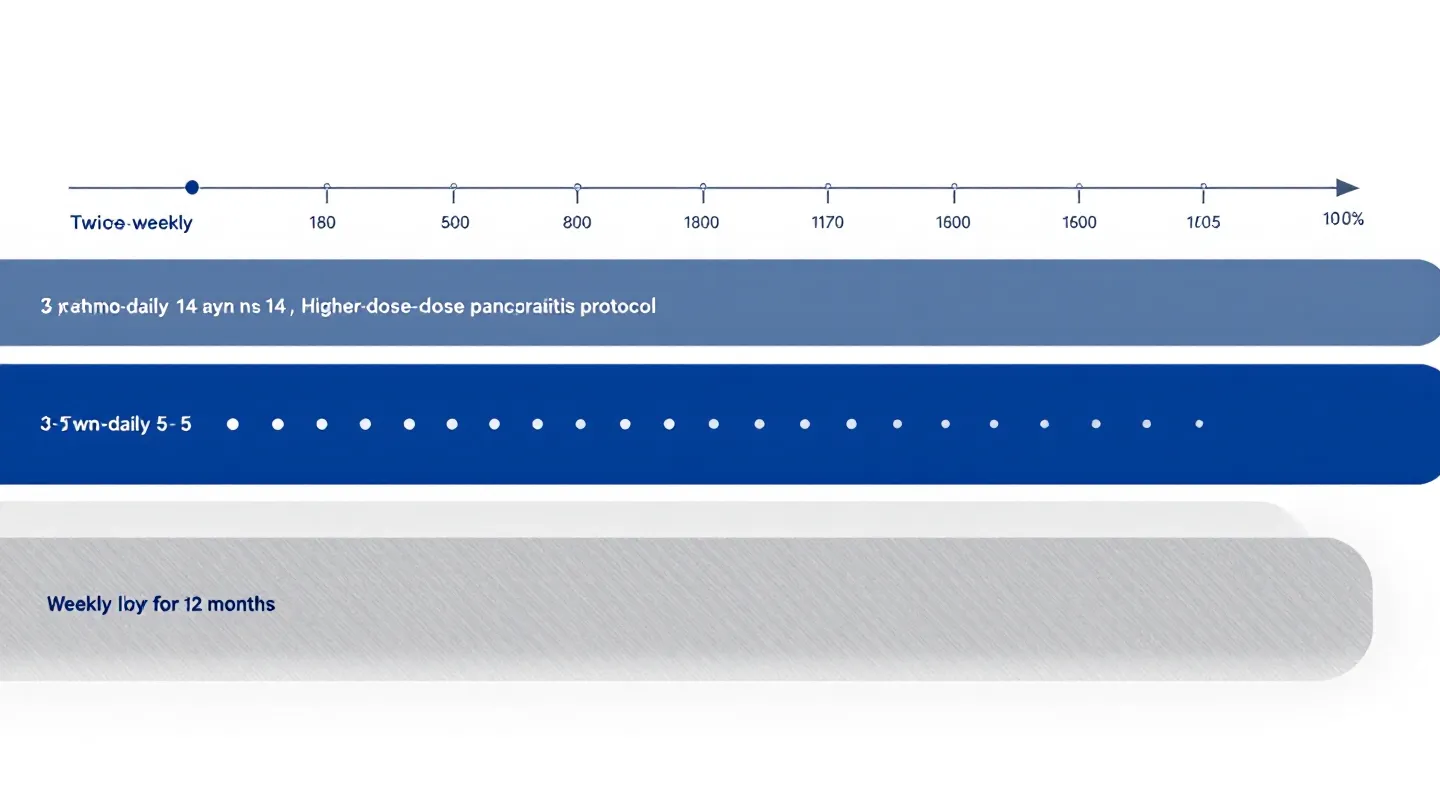
This page documents the dose ranges used in clinical trials, as research parameters, not recommendations. Thymosin alpha-1 is not FDA-approved, so there is no approved human dose. What trials have actually studied: the chronic hepatitis regimen was 1.6 mg subcutaneously twice weekly for six months [2][3]; the sepsis protocols used 1.6 mg every 12 hours for five to seven days [6][16]; the pancreatitis pilot used 3.2 mg twice daily for seven days [8]; a lung cancer adjuvant study ran weekly injections for 12 months [14]. Subcutaneous injection is the only route in all major trials. The peptide has a two-hour half-life, clearing blood levels within 24 hours — which is why the repeated-injection schedules above are the norm. None of this constitutes guidance on how to use the compound.
Research Context Framing
Thymosin alpha-1 is not FDA-approved for any indication. Research-labelled thymosin alpha-1 remains on sale in the United States, alongside a route to prescribed medication that requires a clinician's decision. The dose parameters described on this page are extracted from published clinical trial protocols — specifically, what investigators administered to study participants under IRB-approved conditions. None of this information constitutes dosing guidance or a recommendation for any use.
The data is organized by indication as studied in the research literature. Where multiple trials examined the same indication with different protocols, both are noted. Where a single protocol was dominant across trials (as is the case in hepatitis), that protocol is identified as the standard used across the literature.
Pharmacokinetics
Human pharmacokinetic data for Tα1 after subcutaneous administration shows an elimination half-life of approximately 2 hours. Time to maximum plasma concentration (Tmax) is 1–2 hours after injection. Blood levels return to baseline within 24 hours. Volume of distribution is approximately 5–8 liters, consistent with distribution in extracellular fluid rather than deep compartment sequestration.
Tα1 is a highly acidic peptide with a pI of approximately 4.2. It does not extensively bind plasma proteins. Metabolic clearance occurs primarily via proteolytic degradation by tissue and circulating aminopeptidases. The lyophilized formulation is stable; the N-terminal acetylation that is essential for biological activity is preserved in the synthetic form.
The 2-hour half-life with 24-hour return to baseline is the pharmacokinetic basis for the twice-weekly and twice-daily dosing schedules seen across the clinical trial literature — the rationale is repeated pulsatile stimulation of the TLR2/TLR9 pathways rather than sustained plasma exposure.
Doses Studied by Indication
Chronic Hepatitis B and C (standard clinical trial regimen): The predominant regimen studied across hepatitis B and C trials was 1.6 mg administered subcutaneously twice weekly. In the You et al. hepatitis B trial [3], this regimen ran for 6 months. In the Sherman et al. hepatitis C combination trial [2], the same 1.6 mg twice-weekly subcutaneous schedule was used alongside interferon-alpha. In the Lim et al. hepatitis B combination trial [4], the dosing was 1.6 mg subcutaneous three times weekly for 24 weeks (the interferon arm's schedule drove the increased weekly frequency). The 1.6 mg twice-weekly regimen represents the most consistently used schedule across the hepatitis literature — it is the schedule for which thymalfasin received approval in the ~35 countries where it is authorized as a pharmaceutical.
Severe Sepsis — ETASS Protocol [6]: In the ETASS multicenter RCT, Tα1 was administered at 1.6 mg subcutaneously twice daily for five days, followed by 1.6 mg once daily for two days (total 7-day protocol). This front-loaded schedule was designed to address the acute phase of sepsis-induced immune paralysis, where rapid restoration of HLA-DR expression is the pharmacodynamic target. The same 1.6 mg subcutaneous twice-daily protocol was used in other sepsis trials included in the 2016 meta-analysis [7].
Severe Sepsis — TESTS Protocol [16]: In the TESTS phase 3 RCT, the same subcutaneous injection every 12 hours for 7 days protocol was used — equivalent to twice daily at 1.6 mg. No mortality benefit was found at this dose and schedule in the larger phase 3 population.
Severe Acute Pancreatitis [8]: The pilot double-blind RCT used 3.2 mg subcutaneously twice daily for 7 days — double the sepsis trial dose. In the 2025 meta-analysis of SAP trials [14], the dose range across included studies was 1.6–3.2 mg subcutaneously twice daily.
Non-Small Cell Lung Cancer Adjunct [14]: Weekly subcutaneous injection for 12 months after completion of concurrent chemoradiotherapy. Specific per-injection dose was not individually reported in the retrospective analysis.
Metastatic Melanoma / Checkpoint Inhibitor Sequence [9][10]: Subcutaneous administration in a clinical practice setting; individual per-injection dose was not specified in the retrospective reviews. Tα1 was administered sequentially before anti-CTLA-4 therapy, not concurrently.
Route Considerations
Subcutaneous injection is the sole route studied in all major clinical trials. No intravenous or intramuscular administration has been studied in the human clinical trial record. In vitro studies have used concentrations consistent with physiological plasma range for mechanistic characterization.
The 2025 aging review [17] notes that thymalfasin is typically administered subcutaneously in clinical settings across all studied indications. The lyophilized formulation requires reconstitution prior to injection; the reconstituted preparation is administered subcutaneously at the sites specified in clinical protocols.
The route distinction matters pharmacokinetically: subcutaneous injection produces a Tmax of 1–2 hours with a 2-hour elimination half-life, consistent with the twice-daily or twice-weekly pulsatile dosing schedules that characterize the trial literature.